Knowledge journal / Edition 1 / 2017
Citizen science project shows the value of citizens as scientists
The ‘Freshness of Water’ project is the first citizen science study in the Dutch drinking water sector. Research was conducted with citizen scientists in Amsterdam into the ‘freshness’ of their own drinking water, particularly the bacterial composition.
In recent years citizens have increasingly been involved in gathering and co-creating knowledge and innovation: citizen science. However, if you look at the Dutch drinking water companies we see that they are still making little or no use of the talents, ideas and manpower of customers and citizens. In order to gain greater insight into the possibilities and value of citizen science in the drinking water sector, KWR Watercycle Research Institute worked with Waternet to set up a practical citizen science experiment which is unique for the Netherlands: Freshness of Water.
Freshness of Water
The ‘Freshness of Water’ pilot project brought together various social science and natural science questions for examination. Hence the pilot was designed to answer both questions such as “What is the participants’ background and ambition” and “What significance do citizen scientists attach to their involvement” and to questions like “How does the bacterial composition of drinking water change during transportation and after stagnation?” and “To what extent does the bacterial population of drinking water produced in the west of Amsterdam differ from drinking water produced in the east of the city?”. In the study, citizen scientists took water samples at their home and performed analyses themselves. Samples were also transported to the KWR laboratory where the latest DNA techniques in the field of ‘Next Generation Sequencing’ were performed, making it possible to classify millions of bacteria at the DNA level. The engagement of the citizen scientists involved was also essential in this part of the research because they supplied samples from their tap water immediately after getting up in the morning, a type of sample that is impossible or very difficult for regular samplers to collect. The (interim) results were shared with the citizen scientists involved and evaluated together.
85 registrations
A prerequisite for every successful citizen science project is citizens who are willing to volunteer. In Amsterdam we launched the first citizen science project in the Dutch drinking water sector. An announcement with the option to link through to a specially created Facebook page about the background to the project resulted in 85 complete registrations. This was far more than the maximum 50 volunteers we were looking for.
Analysis of the registration show the majority of the Amsterdammers who wanted to participate as citizen scientists (i) are female (66%), (ii) were aged between 25 and 34 (32%), (iii) had a degree (47%) and (iv) had not previously participated in a scientific study (62%). However, those registering included people from all age categories and from various educational backgrounds. For 35% making a contribution to innovative scientific research was the most important motivation for participating, 26% had a special interest in drinking water, and 21% thought it would be fun to sample and carry out measurements themselves.
Important for the natural science component of the research was also the fact that the participants should have a geographical spread across the city of Amsterdam, so that drinking water originating from the two Amsterdam drinking water production locations (Leiduin and Weesperkarspel) and the mixed zone could be measured. The geographical spread was determinant in the final selection of participants (Figure 1). Only then was demographic variety considered, whereby account was taken of the male/female ratio, age distribution and educational background. Of the 50 Amsterdammers selected, 43 participants confirmed their participation.
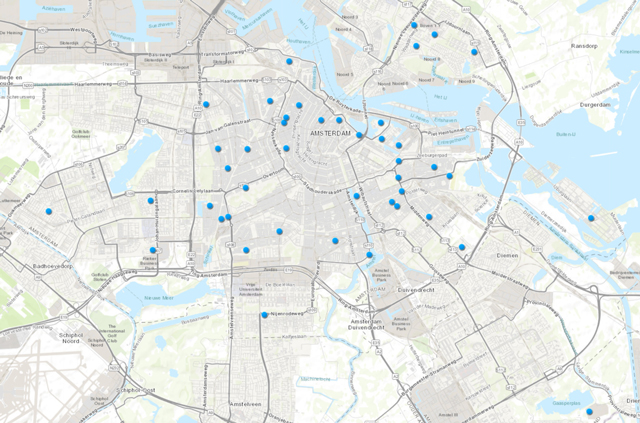 Figure 1 - Participating citizen scientists at postal code level
Amsterdammers become citizen scientists
In order to introduce the selected participants to the background and objectives, the project started with a kick-off meeting at Museum Micropia. Subsequently all citizen scientists took water samples at home: two from the kitchen tap, of which one after 1 night of stagnation and one after 5 minutes of running water. Finally the citizen scientists added one sample of their own choice to the experiment, whereby choices were often made for somewhat ‘older’ drinking water from a glass, water bottle, coffeemaker or kettle.
The citizens scientists carried out two water analyses using a test strip. After 3, 5 and 7 days respectively of incubating at room temperature the participants counted the number of ‘dots’ i.e. microbe colonies on the strips. All participants carried out their home tests and share the results. All the samples were also analysed at the KWR laboratory. The laboratory analyses showed that sampling had been carried out carefully by all citizen scientists.
Water is a fresh product
The analysis results for the cultured bacteria show that the drinking water from the tap contains virtually no cultivable micro-organisms. In contrast, drinking water that has been stored in a bottle, glass or water bottle contained many cultivable bacteria, due to bacterial growth. Alongside the citizen scientists’ home analyses, all samples were analysed for the total microbial biomass (ATP) and the total number of bacteria at the KWR laboratory. These analyses showed the same trends as for the cultivable bacteria, with the difference that the number of cultivable bacteria make up only a small fraction of the total number of bacteria in drinking water (<0.1%). This means that most bacteria in drinking water cannot be cultured on the tested culture medium.
In addition, the bacterial composition of the various water samples was determined using ‘Next Generation Sequencing’. This analysis shows that the total number of bacteria species in all Amsterdam drinking water samples from the kitchen tap (immediately and after flushing) was higher than 51,000. This high diversity is larger than has been observed in drinking water of other countries. The reason for this is that outside the Netherlands drinking water is often chlorinated, as a result of which many bacterial species are unable to survive. We expect that the high species diversity improves water quality, because these natural residing bacteria prevent establishment of unwanted micro-organisms in the drinking water environment.
Follow-up research should give a definitive answer to this hypothesis. Another finding is that an important proportion (30-50%) of the bacteria are still unidentified. The bacterial composition of drinking water was found to remain virtually unchanged during the transportation of drinking water to the customer, but the bacterial composition does change at night during stagnation in the home drinking water system, albeit to a small extent. In contrast, when drinking water is stored in a bottle, the bacterial composition changes dramatically, which can be seen in Figure 2.
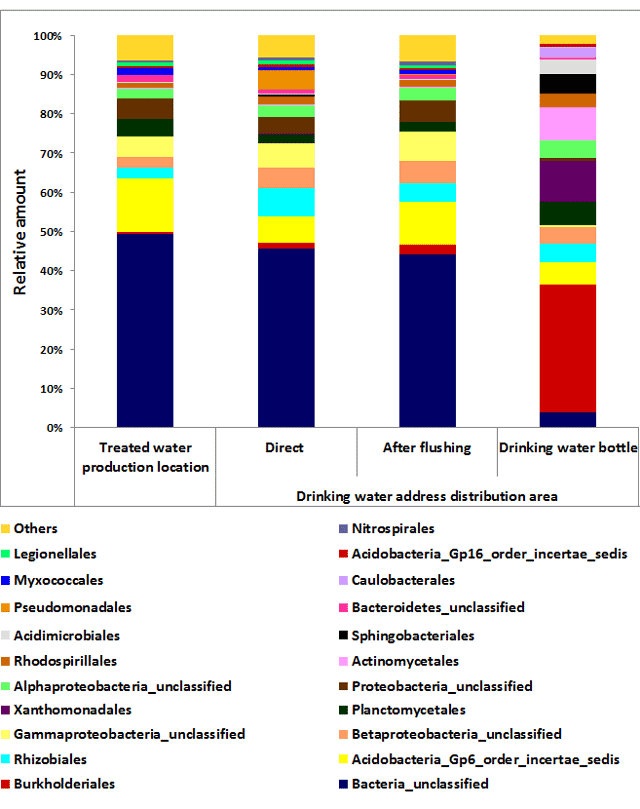 Figure 2 - Example of the bacterial community composition at Order level, measured from the treated water at the production location and at one address in the distribution system. From left to right: treated water production location, drinking water after one night standstill in the premise plumbing system (direct), after 5 min flushing and the same water stored in a plastic bottle.
The bacterial composition of drinking water that is produced in the east of the city differed from the drinking water that is produced in the west of the city (data not shown). This confirmed earlier observations in other supply areas in the Netherlands and abroad. Apparently every production location produces drinking water with its own specific bacterial flora.
Openness and transparency
One important element of the citizen science pilot project consisted of an open interaction with the citizen scientists and transparent feedback of results. This transparency was also new and unfamiliar for the water company and the professional scientists, particularly since it was not known in advance how the results would turn out. Following the start-up meeting, this interaction mainly took place on the “closed” Facebook project page and an interactive GIS map on which all the participants involved shared research results, questions and comments throughout the project. Just under five months after the start, the final results were shared with a wide audience at a public meeting at the debate centre Pakhuis De Zwijger.
The value of citizen science
An evaluation (79% response rate) following the pilot project showed that the citizen scientists felt that their participation was educational (94% and fun (88%). They also indicated that their knowledge and awareness of drinking water was enhanced (91%). The participants indicated far less often that their participation in the experiment led them to modify their drinking water behaviour, such as replacing or running water more often. However, it is interesting that confidence in the quality of drinking water and the water company increased at 65% and 59% respectively of the participants.
A reflective focus group also showed that confidence had increased. Participants indicated that by participating they not only came to see how advanced Waternet's tap water production is, but particularly that they perceive the transparency, including about complicated issues such as microbes, as a particularly confidence-inducing element. Virtually all the citizen scientists involved (97%) indicated that they would certainly consider participating in another citizen science project related to drinking water in the future. A majority of the Amsterdammers involved also indicated that they were open to be involved in issues relating to drinking water in other ways.
Conclusion: There's more to fresh water!
Thanks to the efforts of the citizen scientists involved, we can conclude that the bacterial composition of a fresh product like drinking water changes when it’s transported or stored. At least as important is that we can conclude that involving citizens in research in the water sector works and offers benefits. With the appropriate support they can make a valuable contribution to scientific research. It also makes the citizens involved more conscious, improves confidence in drinking water, and offers office professionals a fun, new and valuable perspective. Based on this experience, Waternet has now started a new citizen science project, KWR Watercycle Research is investing with increasing intensity in research in the area of customer interaction and citizen science, and at least three other drinking water companies are launching research projects in 2017 in which citizens as researcher play a central role.
Stijn Brouwer
(KWR Watercycle Research Institute)
Paul van der Wielen
(KWR Watercycle Research Institute)
Merijn Schriks
(KWR Watercycle Research Institute)
Maarten Claassen
(Waternet)
Leon Kors
(Waternet)
Co-authors: Ellen Schaasberg, Annina van Roode, Arnoud Schouten, Arnoud ten Haaft, Astrid Paulus, Bas Mijling, Bettine Lalieu, Cheyenne Oorebeek, Dia Huizinga, Dionne Pierik, Emiel van der Plas, Eric Krediet, Fleur Prinsen, Frans Peters, Freek Groot, Hugo Lingeman, Hylke Hoekstra, Isabelle Beverwijk , Jacobijn Zeijlemaker, Jean-Marc de Waart, Jouke Rozema , Linda Verstraten, Lisette Scholtus, Margriet Metz, Marije Bouterse, Marijke Blankman, Marijke Dinnissen, Marit Olsthoorn, Marjon Rosinga, Marjorie Bakker, Martijn Wismeijer, Martin Boeckhout, Michiel van der Ros, Monique Link, Peter Dohmen, Sarah Arayess, Sofija Fokeeva, Sophie Raterman, Talita Haasnoot, Tessa Esteban Lopez, Tom Niekamp , Wiebe Sloot, Wieteke Hiemstra (citizen scientists)
Summary
The ‘Freshness of Water’ project is the first citizen science study in the Dutch drinking water sector. In conjunction with KWR Watercycle Research Institute and Waternet, citizen scientists in Amsterdam carried out research into the ‘freshness’ of their own drinking water, whereby the bacterial composition was examined in more detail. The researchers demonstrated that bacterial populations change upon storage of drinking water in a bottle, concluding that drinking water is a fresh product. Insight was also obtained into the social scientific value and significance of citizen science. This study shows that citizen scientists were found to be reliable in sampling and measuring.
Auteurs
Stijn Brouwer
(KWR Watercycle Research Institute)
Paul van der Wielen
(KWR Watercycle Research Institute)
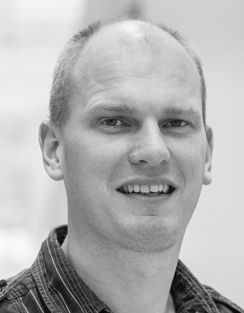
Merijn Schriks
(KWR Watercycle Research Institute)
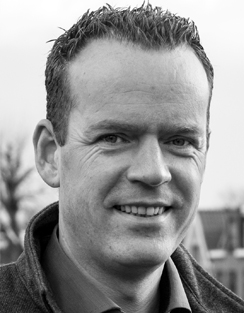
Maarten Claassen
(Waternet)
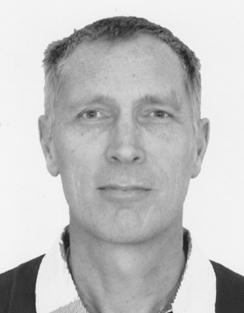
Leon Kors
(Waternet)